Show diversity,
experience education
SGD Otto Altenkirch 1979 K 17

Otto Altenkirch

Landscape - Alla Prima

28. Mar — 27. Sep

As a master of Dresden Impressionist landscape painting, Otto Altenkirch (1875-1945) is overshadowed by Gotthardt Kuehl and Robert Sterl - unjustly!

Heller OA Malend Im Hellergut PetraschOtto Altenkirch malt im Hellergut, 1914 (Ausschnitt) | © Archiv F. Petrasch

Altenkirch had come to Dresden from Berlin with his teacher Eugen Bracht and, after studying at the Academy of Art, had laid the material foundation for his freelance work from 1910 with his position as senior court theatre painter.

In more than four decades, he created over 2,300 landscape paintings, of which around 500 can still be located today. Most of the paintings were created alla prima in and around his birthplace of Ziesar, on the Dresdner Heller and around his residence in Siebenlehn.

Altenkirch perfected the application of colour with a palette knife and was sometimes more innovative than his better-known colleagues with regard to the impressionistic resolution of forms and the reproduction of weather and light moods. Among his contemporaries, he was regarded as "the Saxon Liebermann".

The exhibition aims to provide an overview of Altenkirch's work development and his painting locations.

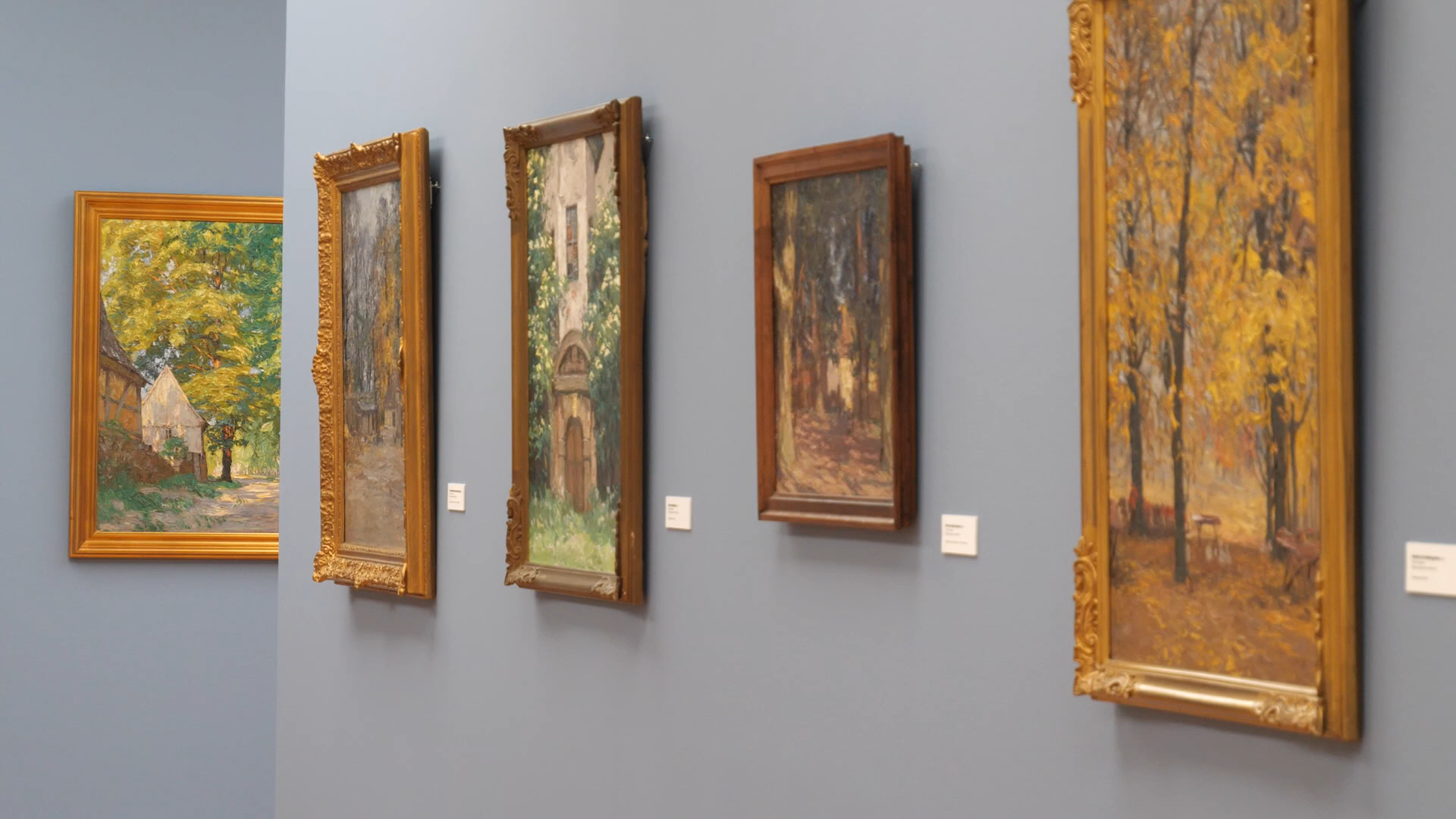
Otto Altenkirch in der Städtischen Galerie

Otto Altenkirch in der Städtischen Galerie
AI generated: The image shows the ruins of an old, weathered building in a barren landscape under a vast, grey sky. The main content is the melancholic scenery of the ruins, surrounded by vastness and emptiness.Bühnenbildentwurf »Parsifal. Einöde«, Otto Altenkirch, 1914, Gouache/Papier, 65 x 48 cm | © Historisches Archiv der Sächsischen Staatstheater Dresden

Stage design: Otto Altenkirch

in 1914, Otto Altenkirch created the stage design for the first performance of "Parsifal" at the Dresden Court Opera as a court theatre painter. An original draft of Parsifal's "Wasteland" is now part of the Semperoper's historical archive. Parsifal is currently back on the programme. Katrin Rönnebeck from the Historical Archive interviewed the stage designer Frank Philipp Schlößmann.

Stage spaces in changing times